
Yesterday, the woman behind the infamous Timothée Chalamet stan account “Club Chalamet” said she was assaulted by another fan outside a Paris hotel where the Heated Rivalry star Connor Storrie was staying. If you don’t know what any of those words mean, bear with me. If you know exactly what they mean, bear with me anyways.
As I watched the discourse about this confrontation unfold, it felt like a manifestation of all the ways algorithmic social media platforms have distorted fandom. The age-old drama within these female-dominated fan communities has been projected onto the screens of the masses, creating a circus of judgment and both internalized and externalized expressions of misogyny. But I’m getting ahead of myself.
Before we get to the reported attack on Club Chalamet, there are a few other things that happened yesterday that are also worth noting.
Zohran Mamdani-endorsed Democratic socialist candidates swept the New York City primaries on a platform of holding corrupt billionaires and landlords accountable, ending genocide and ICE, and making the city more affordable for all. This is amazing news, in line with what I wrote last year about how Mamdani’s win signals a much larger shift to the left in the Democratic party. And no, NYC isn’t representative of the entire country—but I’m calling it now that this shift isn’t limited to NYC.
The Prairieland defendants who were on trial for protesting ICE on a night that led to a nonfatal shooting of a police officer have been sentenced to decades in prison. Some of these people were just peacefully protesting and sharing leftist zines. This is a really disturbing development in the Trump administration’s plans to criminalize dissent by labeling solidarity as terrorism.
I finally saw Obsession this week and I have so many thoughts on the runaway horror hit’s cautionary tale about male entitlement and toxic masculinity. That was going to be the main subject of today’s newsletter, but I’m pushing it back because, well, Club Chalamet reportedly got attacked.
So if you haven’t heard of Miss Club before, here’s the lowdown: she’s a 59-year-old Black woman and fandom participant named Simone Cromer who has gained a ton of notoriety online in recent years and even got profiled by the Wall Street Journal in December for becoming arguably the most well-known Chalamet fan. Her fandom activities are pretty standard: she has dedicated fan accounts like Club Chalamet, she pays big bucks to attend entertainment industry events to get a glimpse of her favorite actors, and she occasionally shares incendiary takes about the personal lives of those actors.
In 2023, Cromer’s dramatic response to Chalamet dating Kylie Jenner went viral. Cromer, who was at that point a tiny stan account, was not happy, viewing the pairing as some kind of conspiracy or possibly even Kardashian blackmail. This was a whole moment for the Chalamet fandom, because lots of his (mainly women) fans were convinced he was a sophisticated, mature ingénue instead of the relatively normie bro he has proven himself to be. And of course their anger was directed at Jenner, a common form of fandom misogyny targeting wives and girlfriends that CT Jones wrote about for Rolling Stone at the time.
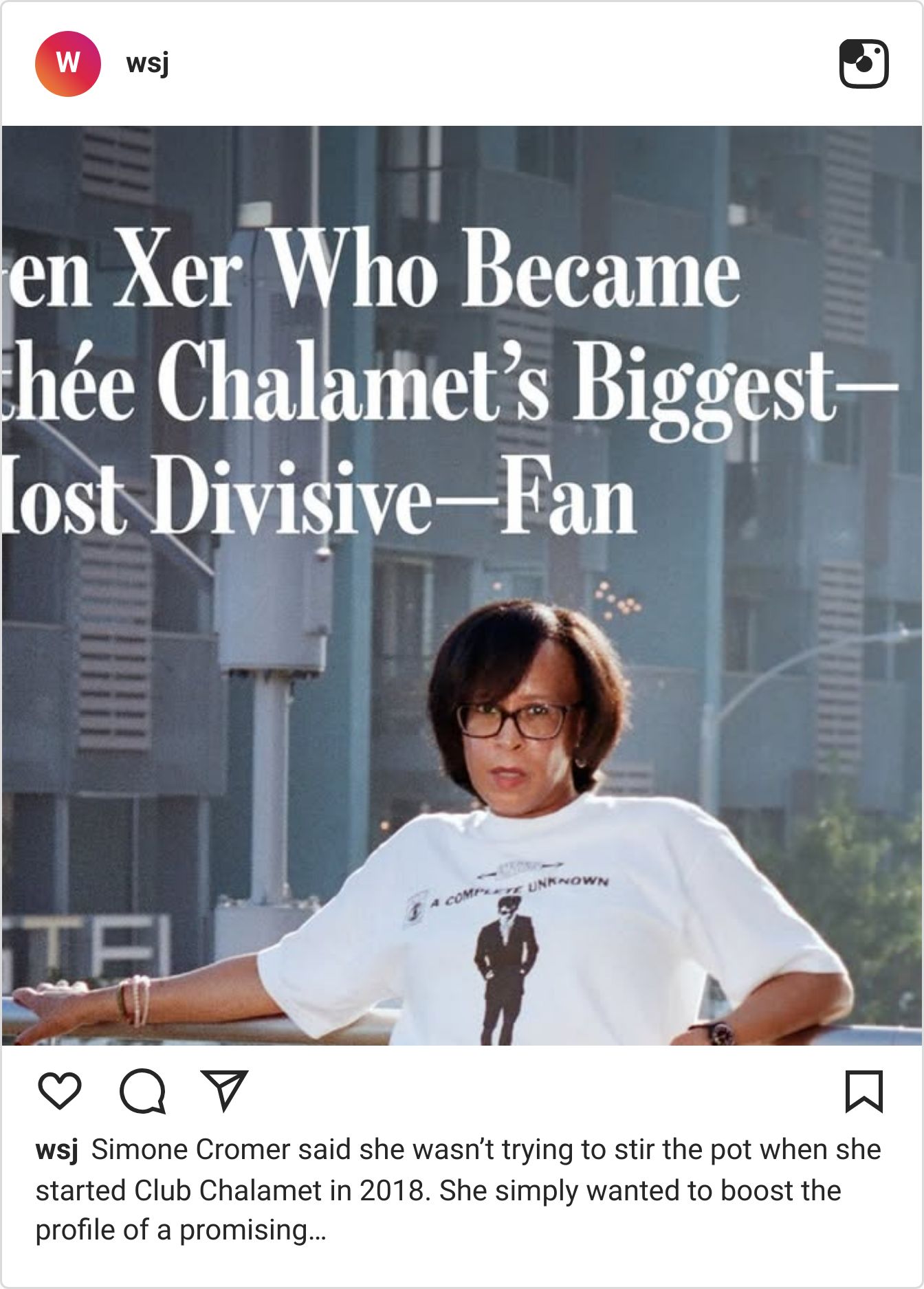
Once Cromer came onto pop culture’s radar, she stuck as a character who was easy to mock. She suffered from similar and different kinds of misogyny that she had perpetuated. Other fans who engage in the exact same behavior refer to her dismissively as “grandma.” (Fun fact: women like Cromer—who I’ll add is not old!—have long been the bedrock of fandom communities since the Star Trek days.) Even if you don’t like Cromer’s takes, which I don’t, reducing her to a “crazy old lady” stereotype is wrong. It’s especially wrong coming from other fans who will inevitably age and become 59-year-old fans themselves.
Even worse, over the past three years, the idea that Cromer is actively dangerous has calcified into some kind of fandom urban legend. I have never seen any evidence that Cromer poses an actual danger to the celebrities she is passionate about. She has met Chalamet multiple times and nothing bad happened. Sure, she’s parasocial. She can also be misogynistic. Welcome to the entire world of fandom and celebrity.
I don’t even think being parasocial is inherently wrong. It’s a natural human response to engaging with public figures. It’s literally what celebrity fandom is. It’s also a marketing tool that celebrities and the entertainment industry at large foster and monetize, now more than ever. There is also a spectrum of parasocial behavior, with some fans certainly crossing the line between devotion and dangerous obsession. But I’ve never seen Cromer do anything that concerning.
Really, what I think is happening here is a combination of misogynoir (when misogyny meets anti-Black racism), ageism, and ableism. Female fans (especially queer female fans, although I don’t know if Cromer falls into that category) have long been pathologized and shamed for behaviors we allow and even applaud from men. Male fans are treated completely differently from female fans, even in the same fandoms. I know plenty of gay men who obsess over women celebrities to a practically unhealthy extent and are viewed as charming and funny for doing it. And a lot of those gay men are openly misogynistic about their favorite celebrities and face little to no blowback!
Cromer’s unusual level of visibility as a fan has instead bred a different kind of danger—danger for her. After Chalamet lost the Best Actor Oscar to Michael B. Jordan this year, Cromer pivoted to become a bigger fan of a different actor: Connor Storrie, one of the breakout stars of the hit fanfiction-inspired gay hockey drama Heated Rivalry. She started a new account called “Storrie Glorrie.” This apparently upset a lot of other Heated Rivalry fans who felt like Cromer would pose an issue in their fandom. But really, the Heated Rivalry fandom was a mess long before Cromer joined it.
Yesterday, word hit the timelines that Cromer had been attacked by another Storrie fan outside a hotel he was staying at for Paris Fashion Week. Cromer then took to Storrie Glorrie to explain what happened from her perspective, while the anonymous nonbinary fan involved shared their perspective. This wasn’t the brawl people initially imagined, although Cromer accused the anonymous fan of trying to remove her SPF face mask and the anonymous fan denied this, saying they only grabbed Cromer’s arm because they thought she was “unstable” and capable of harming Storrie. Which I think is an unfounded escalation.
The anonymous fan was also egged on by other Heated Rivalry fans in real time on X who wanted them to physically attack Cromer and even suggested killing her. I’d argue this kind of rhetoric is more frightening than Cromer’s own fandom behavior. To me, the whole interaction is symptomatic of an online culture of interpersonal surveillance and conflict, aided by algorithms that push more extremist beliefs and offline behaviors.
And when it comes to fandom drama, the intracommunity conflict explodes into public view, turning into a mass spectacle thanks to the same algorithms. Outsiders characterize everyone standing outside a celebrity’s hotel as equivalent “stalkers.” The most popular meme responding to the incident was a remix of a 2020 Tumblr post that said “not to be insensitive but some of the salem witch trials were so funny bitches like ‘i saw her at the devils sacrament!!!’ girl… what were YOU doing at the devils sacrament.” In this case, the “devils sacrament” was waiting outside Storrie’s hotel to see him exit.

L: Timothée Chalamet attends the 98th Annual Oscars at Dolby Theatre on March 15, 2026 in Hollywood, California. (Photo by Jeff Kravitz/FilmMagic)
R: Connor Storrie at the Saint Laurent fashion show as part of Paris Men's Spring-Summer 2027 fashion week held at Bourse de Commerce on June 23, 2026 in Paris, France. (Photo by Jérémie Leconte/WWD via Getty Images)
I think the witch-burning meme is especially accurate here, because those women in Salem weren’t actually witches, and the average fan standing outside a celebrity’s hotel isn’t a stalker, either. Stalking is a very real, very serious crime. It’s most frequently perpetrated by individuals who are already known to their victim. The most common kinds of stalkers are former intimate partners and acquaintances, not fans. Stalking results in the victim fearing for their safety and experiencing distress. This is not an accurate term for what most fans do, and it actually waters down the reality of stalking and how terrifying and devastating it is for everyday people.
Ironically, the anonymous fan who accosted Cromer for supposedly being a “weirdo creep” made a similar point in their thread, writing “Fan presence outside the hotel and the events is part of the PR for the brands. They want that, they count on that. And they plan for it, with security, professional photographers, etc. It looks good having a bunch of fans screaming their ambassador's name.” I think this is true! So why act like Cromer is doing something wrong compared to everyone else there?
In the fallout of the incident, other Heated Rivalry fans have been justifying it by pointing to Cromer’s objectionable politics—her retweeting far-right propaganda, defending Israel during its ongoing genocide of Palestinians, supporting J.K. Rowling’s transphobia, and probably other stuff I don’t even know about. These are obviously things I disagree with, but it doesn’t really have much to do with the confrontation. Rather, it’s a backward justification meant to excuse something else, a moral pretense predicated on digital surveillance.
If Cromer bothers these people so much, I have to wonder why they even know so much about her. She’s not a person in power. If they just ignored her, she would lose the very clout that gives her a platform. Instead a kind of anti-fandom has formed around this fan, and it’s causing real-world chaos.
It’s also directing outsized scrutiny toward women who engage in typical and even encouraged fan behaviors, versus fans who pose a real threat to people around them. I actually think male-driven fan behaviors are far more violent and concerning at scale. Domestic violence spikes during sporting events, because male fans are more likely to abuse their intimate partners after their team loses (or even wins) a game. You just don’t see that with women who care a lot about Heated Rivalry.
I would also be a hypocrite if I acted like these female fans were crazed stalkers, because I’ve done the exact same thing. Back in 2018, on the eve of my 21st birthday, one of my best friends and I waited eight hours outside a Manhattan studio Lady Gaga was spotted entering to catch a glimpse of her for about five seconds. It was really fun to bond with the other fans in line, and I don’t think Lady Gaga cared in the slightest. That’s why she left out the front door instead of the back. When I revisit the paparazzi photos from that night, I can see I was the only woman visible in a crowd of fanboys. But they don’t receive the same kind of judgment that fangirls do.
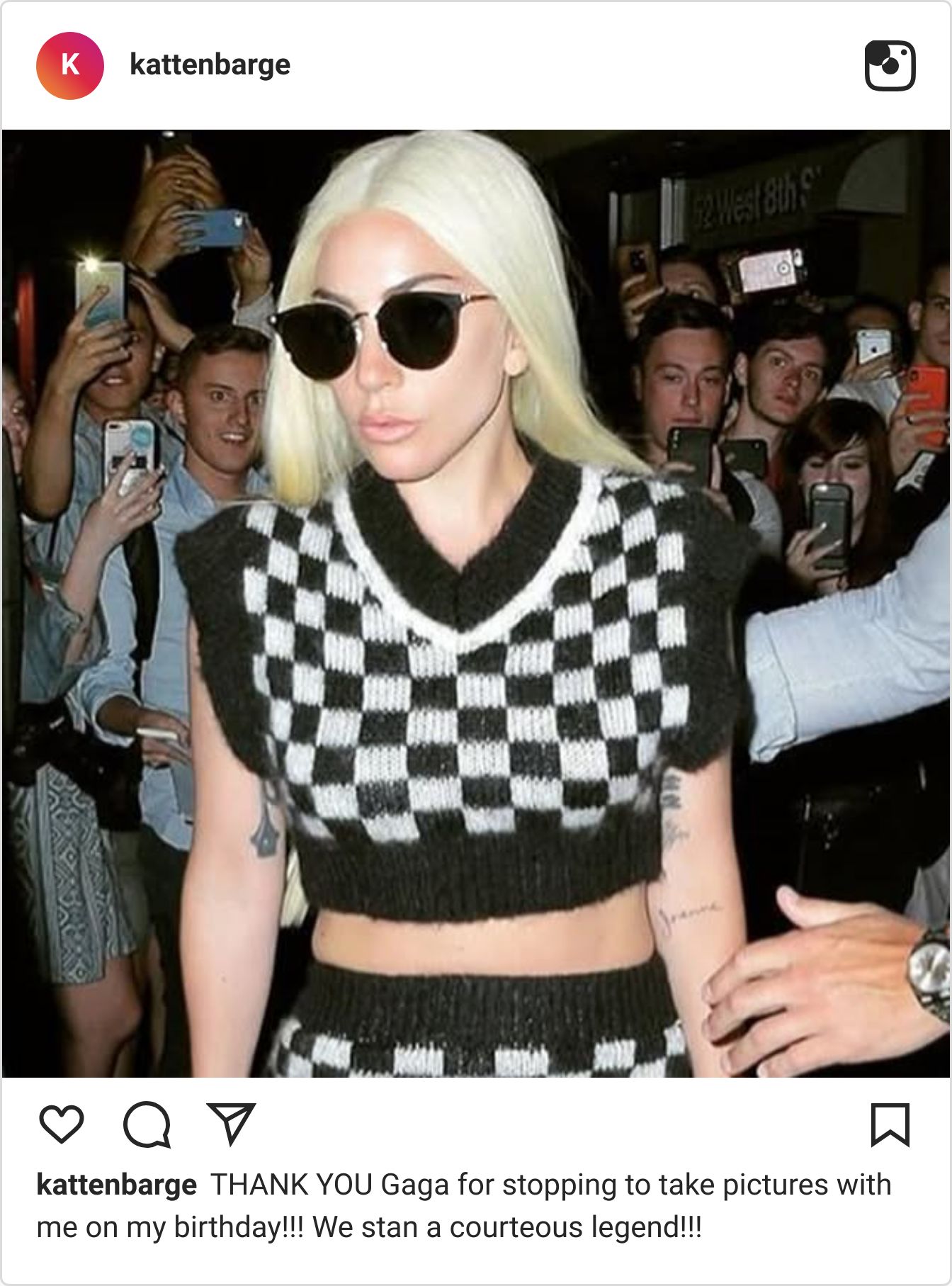
Of course, if the celebrity expresses their discomfort with this, I think fans should stop. But notice what happened when Chappell Roan did exactly this. She became the villain. Notice how it’s always the women who are the villains in a situation, even if they’re on opposite sides of the issue. You can’t win as a female fan or celebrity.
Ultimately, so much of this comes back to misogyny. Fans express misogyny toward their fave’s partners and toward each other. And fans are viewed through a misogynistic lens, which distracts from more aggressive forms of misogyny around fans and fandom. Because of social media algorithms, a lot of what would have simmered inside fandom communities on Tumblr ten years ago is now broadcast to everyone to comment on. I can practically guarantee you this won’t be the last meta-controversy to involve Club Chalamet.
