
Well, this has been a depressing week for sexual violence survivors and their allies.
The first thing I want to share—the good news—is that we raised over $300 for immigration legal services in Maine. There are so many overlapping crises right now that deserve our attention, and ICE’s brutal occupation of American cities is one of them. We also know that ICE employees have reportedly sexually abused hundreds of detainees in recent years, with complaints that rarely even get investigated.
This week, I’ve spent an enormous amount of time thinking about how so-called systems of justice fail survivors of sexual violence. I was able to see the Australian documentary Silenced, which was screened at the Sundance Film Festival but has yet to secure an international distributor. It profiles women around the world who have been sued for defamation in retaliation for reporting sexual violence, including Colombian journalist Catalina Ruiz-Navarro, Australian former political staffer Brittany Higgins, and American actress Amber Heard.
“Even the most privileged, the most resourced, and the most well-connected women can still fall victim to this, so imagine if you don’t have those resources,” Silenced director Selina Miles told me in an interview. Alongside #MeToo, victims have been encouraged to report and speak out about sexual violence, but what they aren’t always warned about is how much risk they take on in doing so. “This is a global issue,” Miles said. “It’s happening to everyday women who can’t afford to pay for a defense.”
What I’m learning from the Epstein Files
As I was absorbing Miles’ documentary, the Department of Justice released 3.5 million more pages in compliance with the Epstein Files Transparency Act, the deadlines and nature of which it has failed to fully comply. The DOJ has released only some of the Epstein files and it has redacted them so poorly that it has endangered the lives of some of Jeffrey Epstein’s victims. Over the past week, the public has pored over the newly released documents, with some excerpts and interpretations going viral. These include email exchanges with Peter Thiel and Elon Musk, a meeting with 4chan creator Christopher Poole, horrific allegations involving Donald Trump, and a defense of Epstein written by famed linguist Noam Chomsky. That is just skimming the very surface of what the Epstein files reveal about his network, inner circle, and operations. It will take years and the work of countless individuals to fully parse their contents in public. What they already reveal is devastating about the impunity with which mainly men abuse mainly women and girls.
The social media discourse around this has been particularly difficult to bear, mainly because it is so disappointing to see how people grapple with the pervasiveness and permissive structures that enable and actually encourage sexual violence. A lot of times, people try to find the humor in it and leave it at that. Most times, people dramatically understate the crisis of abuse. In the worst occasions, people reject the idea that sexual violence is wrong. They refer to this case as “boring” and reframe Epstein’s crimes as normal and acceptable behavior.
The women who were victimized by Jeffrey Epstein are centered in the discourse around his crimes—but they have individually been silenced. Virginia Giuffre died by suicide. Women including Maria and Annie Farmer, Sarah Ransome, Lisa Phillips, and Jess Michaels have spoken publicly about surviving Epstein, but their names are not the ones people focus on or listen to the most. Epstein’s name is the default, along with some of their other abusers and the other powerful people who enabled their abuse. Then there are the many victims who are anonymous, because identifying themselves would be too dangerous. And then there are the many victims who never felt safe or able to speak up at all.
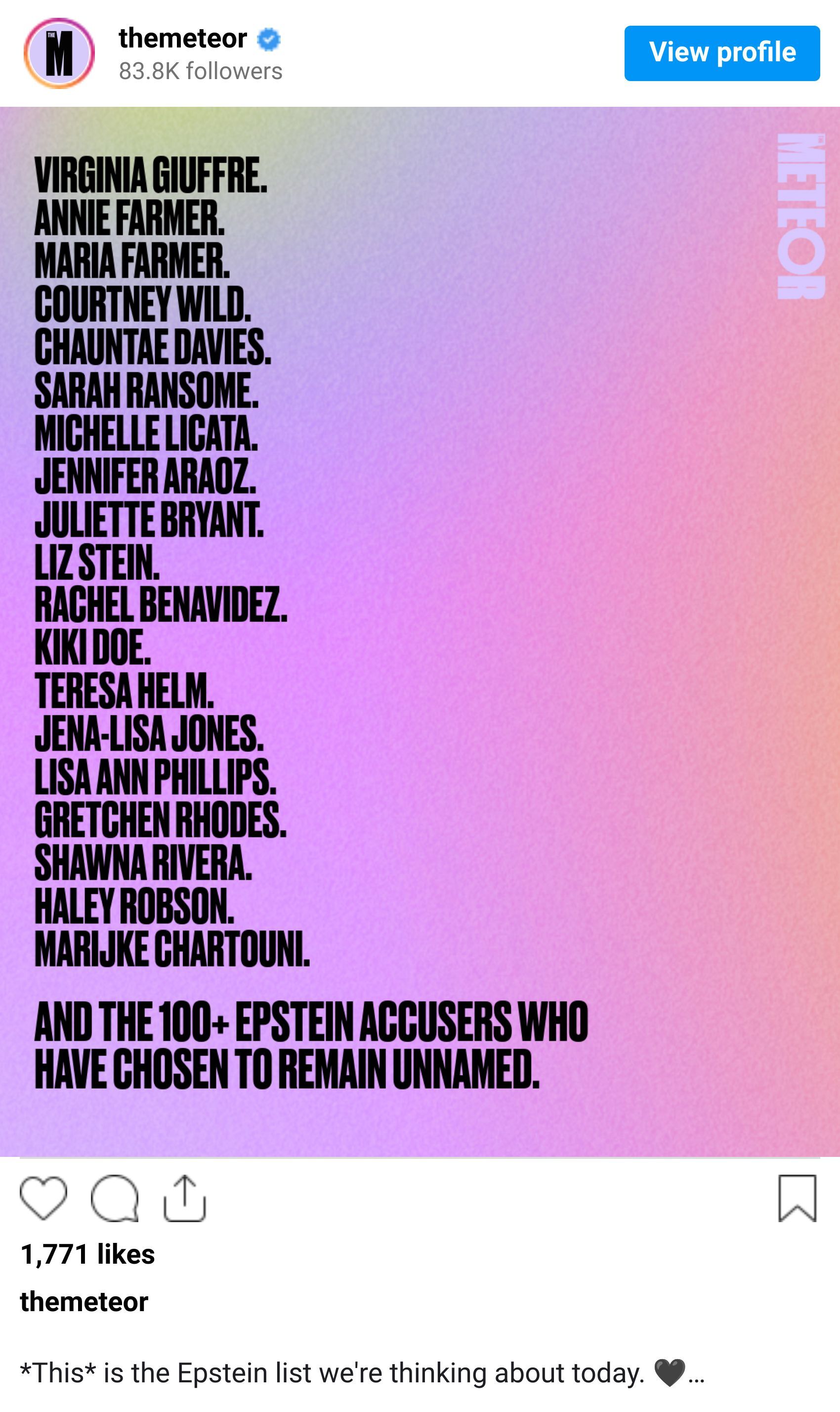
This is part of how and why we fail to support survivors. We obsess about survivors, but we do not listen to them. We do not consider them as the individuals they are. We speak about them, but rarely to them. Even rarer are survivors given the platform to speak. Survivors have to fight to create their own platforms, and many survivors are tired of fighting.
When survivors do speak, they are often ignored. Maria Farmer reported Epstein to the FBI all the way back in 1996. It is unclear what, if anything, the FBI did with that report. Other times, when survivors speak, they are punished for it. When a group of Epstein’s survivors pressured Congress to force the DOJ to release its case files, the DOJ published them late, incomplete, and full of redaction errors. They sloppily attempted to cover up the names of perpetrators and enablers, while they exposed the names, email addresses, and even nude photos of dozens of victims. They destroyed the anonymity that many of these women desperately needed to protect their lives. They pleaded with the DOJ to take their information down, and the DOJ only partially complied, because a journalist I spoke to days later said he was still able to download everything from the government’s website.
The DOJ and Deputy Attorney General Todd Blanche, who has represented Trump personally, is now refusing to investigate Trump any further. Most of the figures named in the most viral excerpts from the Epstein files, including those he was clearly close with, have strenuously denied any criminal involvement. A few people in power, mainly in the U.K., have voluntarily stepped down because of how they appear in the files. But what I’ve learned, and what I already knew, is that we can’t trust the U.S. government to get justice for these victims. Institutions often harm victims in new and additional ways instead following their own rules to hold perpetrators accountable.
What I’ve also learned is what the public has yet to: we can’t move forward from these endless cycles of abuse until we pay attention to victims, empower them to speak up and set agendas, and support them in recovering and thriving after abuse. Right now, we’re doing the opposite of all of those things. If you want to help, I would start by listening to survivors in their own words and on their own platforms, some of which I’ve linked above to their names.
Lawfare silences victims and journalists
Legal systems don’t just punish victims of sexual violence for speaking out. They silence them, stopping them from being able to speak out any further. One of the most common techniques to do this today is to file a defamation lawsuit. Silenced explores this global phenomenon through the lens of both high-profile and under-examined cases. One of them is Brittany Higgins, who reported being raped in Australia’s Parliament House by a fellow staffer. In a stunning display of irony, Higgins’ former boss and senator Linda Reynolds has already threatened the Silenced producers with a defamation lawsuit if the film suggests she tried to stop Higgins from speaking out.
“These kinds of silencing lawsuits have a chilling effect for not just victims, but for journalists as well,” Miles said, speaking generally and not about Reynolds’ specific threat. “That’s probably part of the reason why we’re not hearing about this, is because it’s too dangerous for journalists to report on it.”
Defamation has long been used as a form of retaliatory legal warfare, or “lawfare,” against victims and journalists. But the trend has escalated significantly in the past decade, partly inspired by Johnny Depp’s successful defamation lawsuit in the U.S. against Amber Heard. Silenced was inspired by the book How Many More Women?, coauthored by Jennifer Robinson and Keio Yoshida. Robinson worked directly with Heard when Depp sued the U.K. outlet The Sun and lost, with the judge in the case finding evidence that Depp abused Heard throughout their relationship. But when Depp sued Heard directly in the U.S., the case turned into a mass media spectacle that upended the premise of the #MeToo movement. Depp’s victory and the public’s abuse of Heard have inspired a slew of copycats and is now considered one of the major turning points in #MeToo backlash.
Heard’s detractors worked as an online mob to smear not only her reputation, but also anyone who defended her, pushing trending hashtags like “#AmberHeardIsALiar” and #AmberHeardIsAnAbuser” and review-bombing Heard’s lawyers and expert witnesses on Google. They harassed anyone who spoke up in Heard’s favor online. I have folders of screenshots of harassment I received for reporting on the disinformation campaign against her. And now Miles says that anti-Heard trolls are attacking Silenced in a similar fashion, review-bombing the film without even watching it.
“In a way, the response to the film is proving the point of the film,” Miles said. “The lack of empathy, I just find staggering.”
My hope is that Silenced can be distributed in the U.S. and beyond, so that people can really grapple with just how dire the circumstances are for survivors seeking justice. There’s a lot of resistance to the idea that survivors are mainly punished further by the institutions that are supposed to help them, but it’s proven true again and again. If this documentary is given a larger platform, it will broaden perspectives and change minds. Miles told me that some viewers have already told her it changed their minds about Heard. Now we need people to understand the stakes are just as high for every victim.
