
The first post I saw on Thursday was the breaking news that second-wave feminist icon Gloria Steinem had died. The second post I saw was the top comment underneath it, calling her a “baby killing bitch” who was “rotting in hell.” Lovely.
As feminist author Rebecca Solnit wrote on Bluesky later that day, “The status of women advanced astonishingly during Steinem's 92 years on earth.” In no small part thanks to Steinem, in the U.S. we now have women’s media that ties lifestyle to politics (like Spitfire News), abortion rights in 37 states (fewer than before Roe v. Wade was overturned), protections against marital rape and sexual harassment (alongside a bevy of other rights she advocated for), and more women running for office than ever. But as that comment I saw—and the recent rollback of some of the rights Steinem fought for—indicates, we still have a very long way to go.
Some of the other posts I saw Thursday morning were of my friends and peers in the feminist media space paying tribute to Steinem. Just a few weeks ago, several of them attended the final gathering of women journalists in her Upper East Side brownstone apartment, where she spent the last several decades of her life. I never got the chance to meet her, but from what I could tell she was personally generous and inspiring to many.
Of course, any positive reflection on Steinem in the wake of her passing these past few days has been met with a resounding but. And most of what I’ve seen said by regular people online has not been very positive at all. Indeed, all of the aforementioned posts have been met with an avalanche of scathing criticism over Steinem’s work for the CIA in her twenties, which has morphed into a kind of conspiracy that her entire life’s work was a CIA operation to prevent mainstream feminism from incorporating class consciousness. Which, if you actually know anything about Steinem or the issues she fought for, is not really true at all.

Gloria Steinem in May 1970. Credit: Bettmann/Getty Images
Let’s start with the facts: Yes, in her mid-to-late twenties, Steinem led an organization largely funded by the CIA to counter the Soviet Union’s communist programming aimed at global youth. Several years afterward, in the late 1960s, she remained defensive of her CIA work and even called them “enlightened, liberal nonpartisan activists.” (Notably, this interview was conducted several years before it became public knowledge that the CIA had overthrown democratically elected governments in Iran and Guatemala in the 1950s, but it was after the Bay of Pigs disaster, so I’d still say she should have known better.)
Radical feminists have long been extremely critical of Steinem for this CIA work, though she has always staunchly denied claims that she served as a CIA informant, took marching orders from them, or that she continued to work with them in any fashion after she entered the feminist movement in her late thirties, launching Ms. magazine and devoting herself to women’s liberation. Still, her CIA ties have taken center stage in the discourse around Steinem, with many prominent leftist and feminist posters arguing that her legacy is inextricable from that early government funding.
A lot of accounts have shared a Medium article called “Feminist Icon Gloria Steinem Was An Anti-Communist CIA Operative who Kept Feminism From Discussing Class,” written by a publication with a measly 35 followers. Some of the pages boosting it, however, have hundreds of thousands of followers. And upon actually reading this piece, it becomes abundantly clear that it’s not a very reputable source at all. It reframes reproductive rights as some sort of petty bourgeois concern, which is asinine and offensive. It asserts that Steinem influenced second-wave feminism away from issues like universal childcare, which is flagrantly false. And it says that Ms. magazine would “systematically avoid class,” when the outlet has literally always advocated in the interest of welfare recipients, low-wage laborers, and sufferers of economic inequality driven by far-right groups and corporate interests. Finally, as a trans writer named Stefany first discovered, the Medium piece claims that Steinem used her power and connections to bury radical feminist investigations about her, but their source is a far-right antifeminist conspiracy newsletter from the 90s that also trafficked in antisemitism and JFK assassination theories. Yikes!
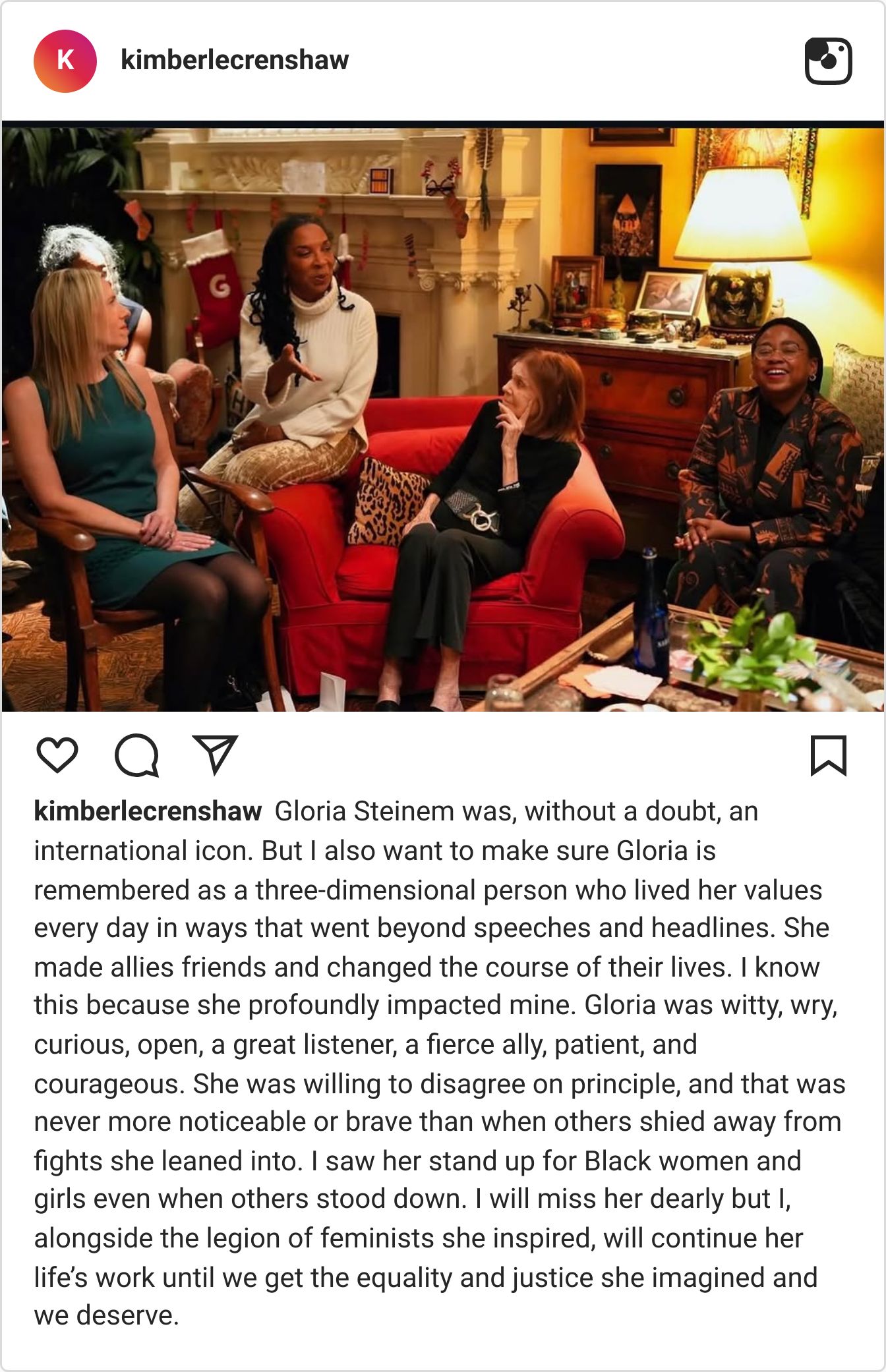
While some second-wave feminists, mainstream women’s media outlets, and Steinem herself have been rightly critiqued, in part for their assimilation into elite institutions over championing the working class and women in the Global South, it is just plain wrong to act like Steinem’s work was entirely devoid of intersectionality or class-based analysis. Kimberlé Crenshaw, who actually coined the terms intersectionality and critical race theory, posted a photo of herself with Steinem on Instagram on Thursday and wrote, in part: “I saw her stand up for Black women and girls even when others stood down. I will miss her dearly but I, alongside the legion of feminists she inspired, will continue her life’s work until we get the equality and justice she imagined and we deserve.”
And do you know what many of the comments on this post are saying? CIA ASSET! CIA PLANT! PERFORMATIVE WHITE FEMINIST! Oh, really? You think you know better than Dr. Crenshaw?
Now, there were things I personally disagreed with Steinem about. To me, her legacy is contradictory (as many are): she was arrested for protesting South African apartheid in the 80s, but she condemned Hamas for sexual violence while Israel committed genocide and performed state-sanctioned sexual abuse against Palestinians. She supported Amber Heard against Johnny Depp and Anita Hill against Clarence Thomas, but she defended Bill Clinton from allegations of sexual harassment. Her views on transgender women changed for the better, but she maintained her exclusionary positions toward sex workers. And throughout her life, Steinem fought with friends and foes in the feminist movement about these disagreements. Andrea Dworkin was furious with her for supporting Clinton, radical feminist organization Redstockings blasted her CIA-funded work, and today’s young feminists are far more likely to condemn Israel.
But what I see happening on social media around Steinem right now is not just principled disagreement or healthy discourse. It’s also misinformation about her views and dogpiling anyone who actually knew her and wants to commemorate the loss of a friend and ally. I understand why some women don’t feel the need to eulogize Steinem; her brand of feminism didn’t serve everyone and could actually hurt the most marginalized women. But the era of second-wave feminism as a whole is not the societal scourge it’s often presented as. Without its gains, we would be subjected to far more forms of gender-based discrimination than we already are.
Thanks to that enormous progress over Steinem’s lifetime, her ideas and positions were often more radical in her early years than they were toward the end. She was embraced and centered by the mainstream over more pioneering, radical, and diverse feminists, not least because she was a conventionally attractive white woman who could mesh better with corporate interests. (Case in point: one of the final Getty Images taken of Steinem featured her ringing the New York Stock Exchange bell with Paris Hilton to celebrate International Women’s Day.) Still, she rejected being called the face of the feminist movement and credited Black feminists and women of color with driving the majority of support for equal rights, as well as the movement’s earliest gains.
When I see the backlash against Steinem, it strikes me as inseparable from the equally overly broad, conspiratorial, and often blatantly false attacks on feminism itself. Even leftists, and especially leftist men, are not immune from conservative attacks on specific women and the movement at large. This is happening alongside successful efforts to undermine the gains of every single wave of feminism, from the right to vote to reproductive healthcare to intersectionality to combatting digital violence.
And if we applied this kind of purity testing to the entire left flank, we’d lose a lot more people than just Steinem. But instead, there are near-constant efforts to uplift white men in particular who have extensive ties to the U.S. government and military, imperfect belief systems, and even records of violence. When leftist men are accused of predatory behavior, you’ll often see efforts to close ranks instead of cast them out, at least until the accusations become so dire that it would otherwise become a PR nightmare. I can’t forget how some of the same people raking Steinem over the coals promoted former Blackwater mercenary Graham Platner and how disinterested they are in the face of ongoing feminist crises like criminalized abortion and rape.
But it’s much easier to criticize a woman, especially a feminist. Everyone is allowed to say their piece on Steinem—and they should be—but that’s not always the case when you’re talking about a dead man. It’s unfortunately still a privilege to evaluate someone’s legacy, and it’s not a privilege that is equally shared.
I think of Ana Murguia, Debra Rojas, Dolores Huerta and the other women who only shared their child sexual abuse, rape, and sexual assault allegations against United Farm Workers co-founder Cesar Chavez decades after his death, out of fear of damaging the Latino civil rights movement. I think of Felicia Sonmez, who was wrongfully suspended by the Washington Post for simply sharing an article about the rape allegation against Kobe Bryant the day of his death. And I think of Karen Attiah, who was wrongfully fired from the Post for voicing her refusal to mourn Charlie Kirk after he was killed.
Attiah, who was just reinstated at the Post after a nearly year-long fight, was one of the last women to visit Steinem’s home as part of that circle of journalists. On Steinem’s legacy, she wrote: “She told us the importance of having attitude in our work, sharing stories, and starting new ideas. ‘Just do it’ she told me. And we will.” You can probably imagine some of the comments on Attiah’s Instagram post.
In addition to Instagram, a lot of this Steinem CIA backlash is happening on X. There’s an incredible irony in that, since it’s a literal billionaire-run right-wing psyop that many leftists keep posting on. But sure, the real threat to our activism is the woman who, however flawed, galvanized millions of people to engage with feminism over her decades of contributions.
My own feminist awakening was after the peak of the second wave, Steinem, and Ms. magazine. I discovered feminism via Tumblr posts, and my ideology further crystallized during Depp v. Heard and the backlash to the #MeToo movement. At my age, Steinem was working with the CIA, and I’m glad to say that’s not going to be a part of my own legacy. But my work wouldn’t exist without hers. She laid the groundwork for us to be better. And based on everything I know about her, she would have agreed with that.
Lindsay Clancy’s trial went from worse to worser
If we need a perfect example of why feminism is so important to the overall success of the left, the Lindsay Clancy case is right there. I wrote about the way conservatives and the manosphere were weaponizing it last week, before it ended with a mistrial on Friday. It has been reported that a single juror prevented a unanimous decision.
This case is unbelievably bleak. Clancy, 36, was charged with first-degree murder for the killing of her three young children in 2023. Her defense argued that she was not guilty by reason of insanity, suffering from postpartum psychosis that was inflamed by a cocktail of medications. Now, her attorney says that the holdout juror was refusing to follow legal instructions and harbored a bias against people suffering from mental illness. On the right, this has turned that juror into something of a folk hero.
Since my first piece, the discourse has only escalated against Clancy and anyone who possesses empathy for her. After my friend Caroline Kwan covered the case on Twitch from a feminist perspective, she received at least a thousand hate comments containing some of the most violent misogynistic rhetoric I’ve seen in a while. Far-right extremist influencer Jake Lang showed up outside the courthouse with signs reading “Liberal Women=Mental Illness” and “We Used to Burn Witches At The Stake.”
As I wrote on Bluesky, this is exactly the type of case the right loves to seize on as a way to build popular support, following in the footsteps of Depp v. Heard and Gamergate. It’s an opportunity to smear the left and left-leaning women in particular as violent and unhinged. The irony that men and especially right-wing men are exponentially more violent toward women and children is lost in the fray of viral moments. Even if people nodding along don’t explicitly identify with the alt-right, they are being sucked into their social media ecosystem and conditioned into their beliefs. It’s a powerful and insidious organizing tool, which is why the right invests so much time, energy, and attention into it.
I think the best way to combat this is to support opposing media efforts like Caroline’s and to drive home the real takeaway from this case, which is that our healthcare and support systems in the U.S. are woefully inadequate to meet the needs of mental health crises and postpartum mothers. It doesn’t have to be this way. We can prevent these kinds of tragedies before they happen. But as long as the prevailing narrative blames and shames individuals like Clancy over broken systems, we are going to see more of these kinds of tragedies unfold. Fewer people will seek help, fearing the kind of stigma that has unfolded around this case. And then the right will capitalize on that suffering to push an even bigger rollback of women’s rights.
The stakes are scary and the bigotry is brutal, but it’s a fight we can win. Just being here and reading this far is a part of it.
