
Content warning: The following story contains details of domestic violence, pregnancy loss, and abuse inside correctional facilities that may be triggering for some readers. Free, confidential help is available 24/7 at the National Domestic Violence Hotline.
When Keshia Golden was eight months pregnant in November 2022, she said her boyfriend and the father of her child slammed her head into her kitchen counter just “for asking a question.”
It wasn’t the first time something like this had happened. Golden had already called the police more than 50 times to report his abuse, according to Chicago’s Cook County Public Defender’s Office. In the previous four months, police had responded to five domestic violence incidents involving Golden and her partner, Calvin Sidney. She had obtained an order of protection against him in July, after she said he punched her in the face during her second trimester.
This time, Sidney had attacked her after her baby shower. Fearing the loss of her pregnancy and her own life, Golden grabbed a knife and stabbed Sidney in the leg. She hit an artery, and Sidney died in the hospital later that day. Golden says she never meant to kill him, but what should have been a clear-cut case of self-defense resulted in a first-degree murder charge.
After being released from the hospital days later, Golden was held under what was initially a $2 million bond. Her public defender, along with community advocates, were able to sway a judge to release her for $5,000. She was able to give birth and fight her case from outside detention. On Monday, rather than face trial and potentially prison for up to 60 years, Golden accepted a plea deal for involuntary manslaughter that will require 24 months of probation.
“There’s still an absurdity to it, right? Because she didn’t mean to kill him, and he was abusing her. So what exactly is she being punished for?” asks Holly Krig, the director of organizing at Moms United Against Violence & Incarceration, who works with women like Golden in the Chicago area. “But, relative to the potential violence of the system, it was a good offer. In order to ensure that she could stay with her child, as she has communicated about a lot herself, she accepted that offer.”
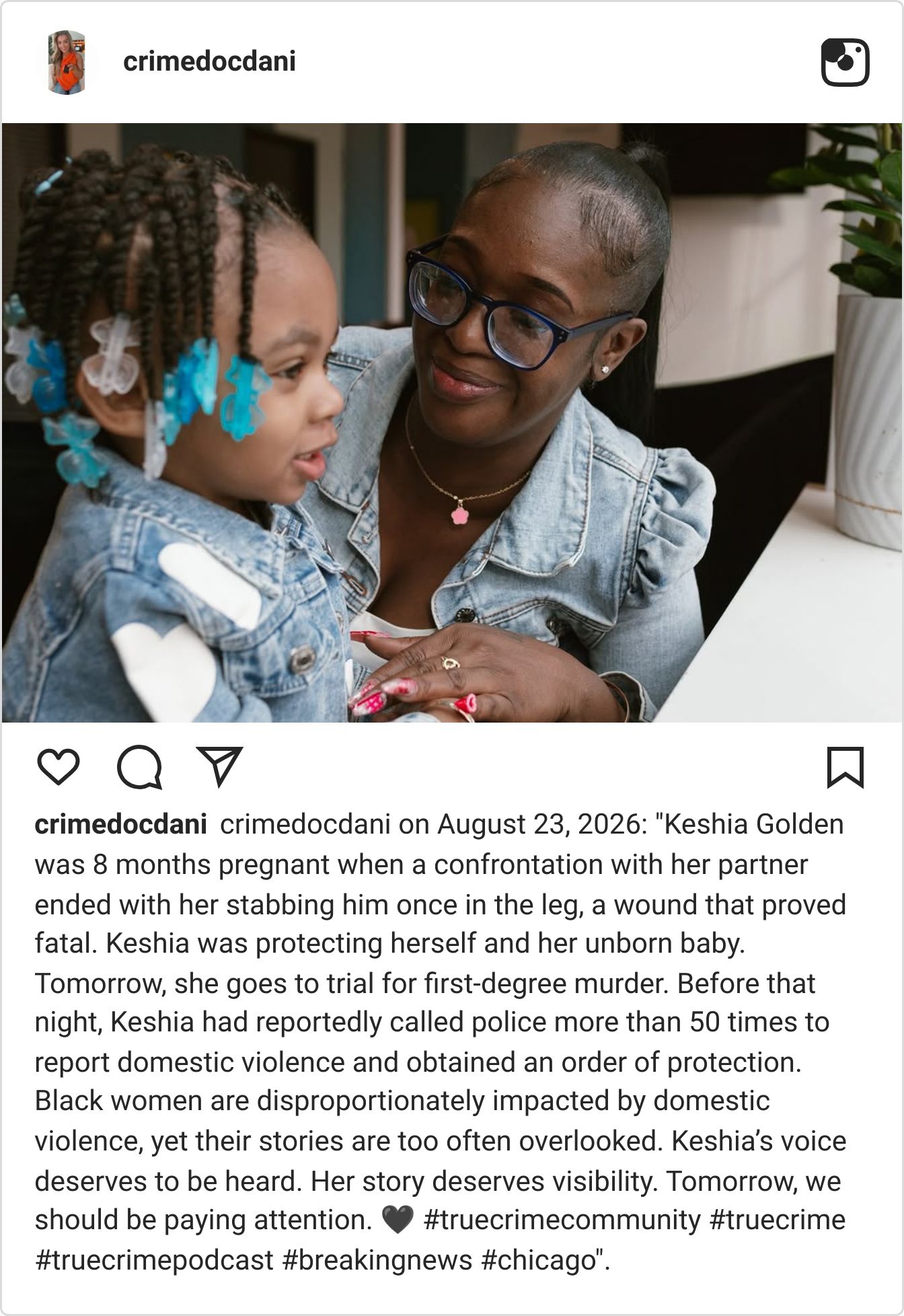
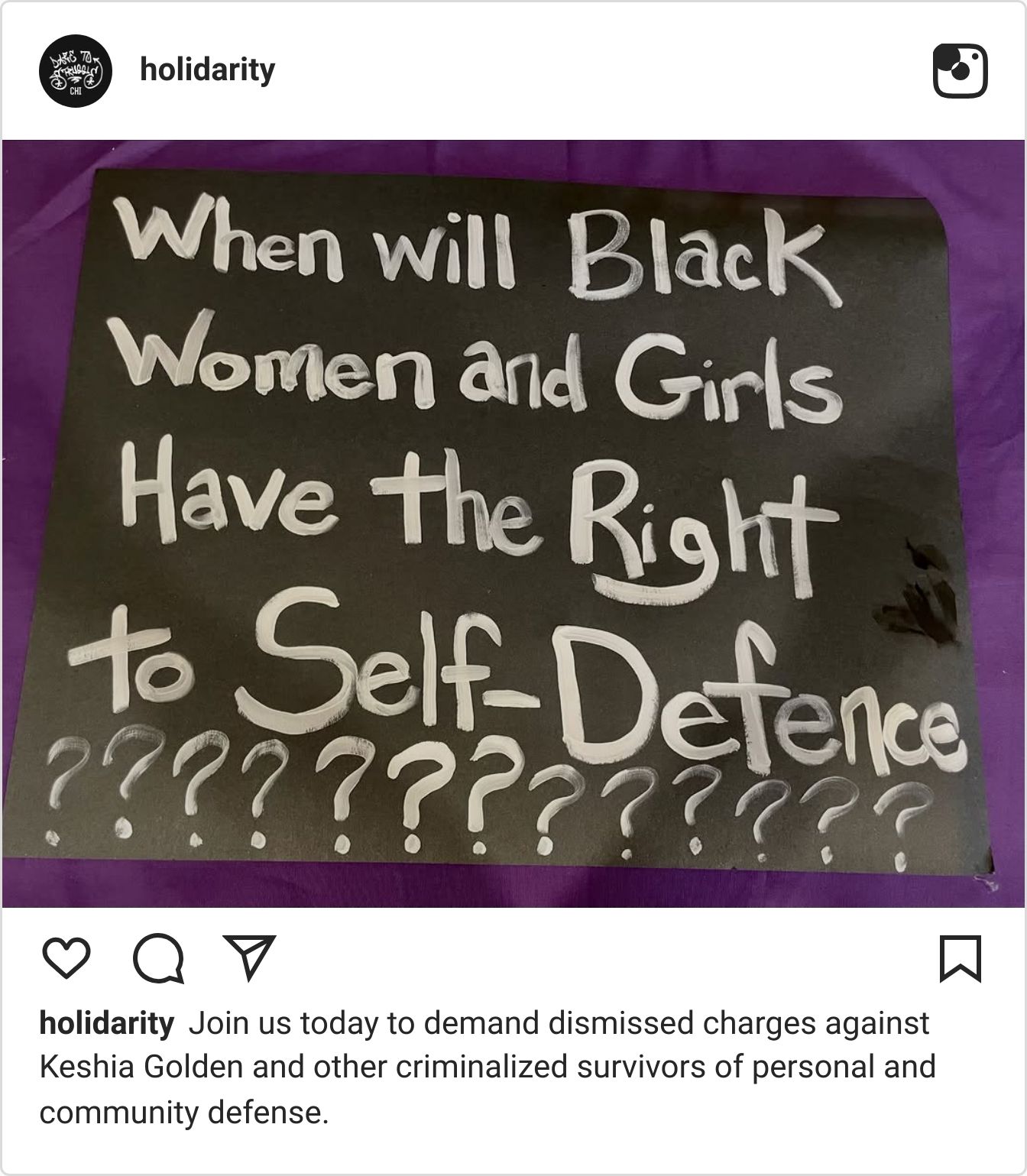
Killing someone in self-defense is legal in Illinois. But Black women in Chicago and elsewhere are disproportionately criminalized for it, even when they are demonstrably victims of domestic violence fighting back against their perpetrator. Black women are already at a significantly higher risk of facing abuse and sexual violence, and the vast majority of incarcerated women are survivors of intimate partner violence.
Despite these known patterns, state attorneys punish women like Golden for surviving abuse and protecting themselves and their children from deadly violence. In Chicago, Cook County State’s Attorney Eileen O’Neill Burke ignored calls from survivor advocates to dismiss Golden’s case, despite telling local news outlets in June 2025 that domestic violence was her top priority.
“Every single time a woman has been beaten, choked, killed in front of her children, it really cuts to my heart,” Burke told reporters. “Those are the cases that wake me up in the middle of the night.” But Burke still leveraged the state’s power against a woman who barely escaped an abusive relationship with her life.
In a statement shared with Spitfire News, the Cook County State’s Attorney’s Office said it “recognizes the complexities of domestic violence and the importance of thoughtfully reviewing the full circumstances surrounding each case. At the same time, the CCSAO is charged with and committed to seeking justice for victims and their families.”
Shanice’s Story
Golden isn’t the first to endure the state violence that too often follows interpersonal abuse, and she tragically won’t be the last. Narratives around being “tough on crime,” even in blue states, can result in criminalizing and subjecting the very victims of violent crime to further state-sanctioned abuse. In the process of learning about Golden’s case, I spoke to two other Black women in Chicago who faced similar biases and injustices after killing their abusers in self-defense. Both were pregnant at the time, and homicide is the leading cause of death for pregnant women. Per their requests, I will be withholding their last names to protect their privacy.
Shanice was a young teenager when her abusive relationship started. Her partner was sentenced to 12 years in prison at age 15, and afterward, he was paroled to her home. Shanice was torn between protecting him and herself. She didn’t want him to be incarcerated again, and she hoped he could get help. But by April 2019, she was 17 weeks pregnant, and the violence had only progressed.
On the day he died, Shanice told me she was sick and simultaneously trying to reach her mother, who was recovering from surgery in the hospital. Her abuser had taken her car keys and left her at home as a way of isolating her. When he returned with another woman, Shanice was in the shower. He dragged her out by her hair and began choking her. As she fought to be released from his grip, her chihuahua began biting his ankles, and he violently threw her dog against the wall. That was when a gun fell from his jeans.
After he left the room, Shanice said she retrieved her own weapon. She had a concealed carry license. Still naked, she exited her room and saw him in the hallway. Shanice lied and said she had called the police. He aimed his gun at her and pulled the trigger, but nothing happened. That was when Shanice shot him. She immediately called 911 and administered first aid herself. When the police arrived, they took her to jail.
In a holding room at the Cook County Department of Corrections, one of the largest pre-detention facilities in the U.S., Shanice said she was refused a bathroom. With no other option, she urinated on the floor. It wasn’t until she was getting processed that she learned she had killed her abuser. Shanice was held for 62 days before receiving a bond of $500,000. She was finally released months later on bail, thanks to the Chicago Bond Fund, then awaited trial without incident while being subjected to electronic monitoring for close to five years.
During the pre-trial period, Shanice endured endless abuses thanks to the backwards justice system. Her address was published, and she said she was harassed by her abuser’s family. While incarcerated, she said she was pressured to have an abortion and forced to take drugs that she believes may have led to giving birth two months early.
Eventually, she was convicted of second-degree murder, but was able to avoid prison time based on her status as a survivor. Today, she defends other criminalized survivors and works as a specialist helping women re-enter their communities after incarceration. Shanice successfully advocated to pass a law in Illinois to ban the use of restraints on incarcerated pregnant women.
“We need to remove the false narratives of asking women things like ‘Well why didn’t you just leave?’ Because it’s not as simple as that,” Shanice said in our interview. “I think a lot of systems don’t realize that some women stay for many reasons, wanting to have help with their children or financial stability or the housing aspect or sometimes just the shame. Or the fact that the abuser puts a wedge between the person and the family, so most times women don’t have anyone to run to.”
Jasmine’s Story
Jasmine struggles to recall the night that her abuser died, but as a result of his inciting attack, she lost her pregnancy. Before being taken to a hospital for a D&C, she remembers correctional employees taunting her and calling her “crazy.” Like Shanice, she was denied the use of a bathroom, even as blood was streaming from her body.
Jasmine was held inside the Cook County jail for two months. She remembers it being cold and nasty—“nowhere for a human to be.” There wasn’t a lot of food, she saw mold in the facilities, and she said guards encouraged the women inside to fight each other.
While detained, Jasmine’s counsel was collecting statements that corroborated the abuse she had faced in her relationship. She had previously called the police and made reports, and even her abuser’s family members contacted Jasmine’s lawyer to provide accounts of him beating her, breaking her nose, and kicking her down a flight of stairs. Following her release, Jasmine was on house arrest for another five years. Despite following the rules, she said she was taken back to Cook County for a period of a few weeks because cops couldn’t read her electronic monitor correctly.
Fortunately, Jasmine’s case was ultimately dismissed, but her fight is far from over. She is still seeking stable housing for herself and her children, including her 1-year-old twin girls. She said her oldest son is “not doing well” after everything that happened. Jasmine is in nursing school and hoping to do more advocacy work for other survivors, fighting to give her family and other women the opportunities she didn’t—and still doesn’t—have.
“You don’t get a lot of help from the governor or the city, and then they treat you very wrong in the jail system when they think that this is something that you may have done,” she told me. “People come from traumatic backgrounds as children, so they run to someone that’s able to provide and give them a stable place, a home, food, clothing, things of that nature.”
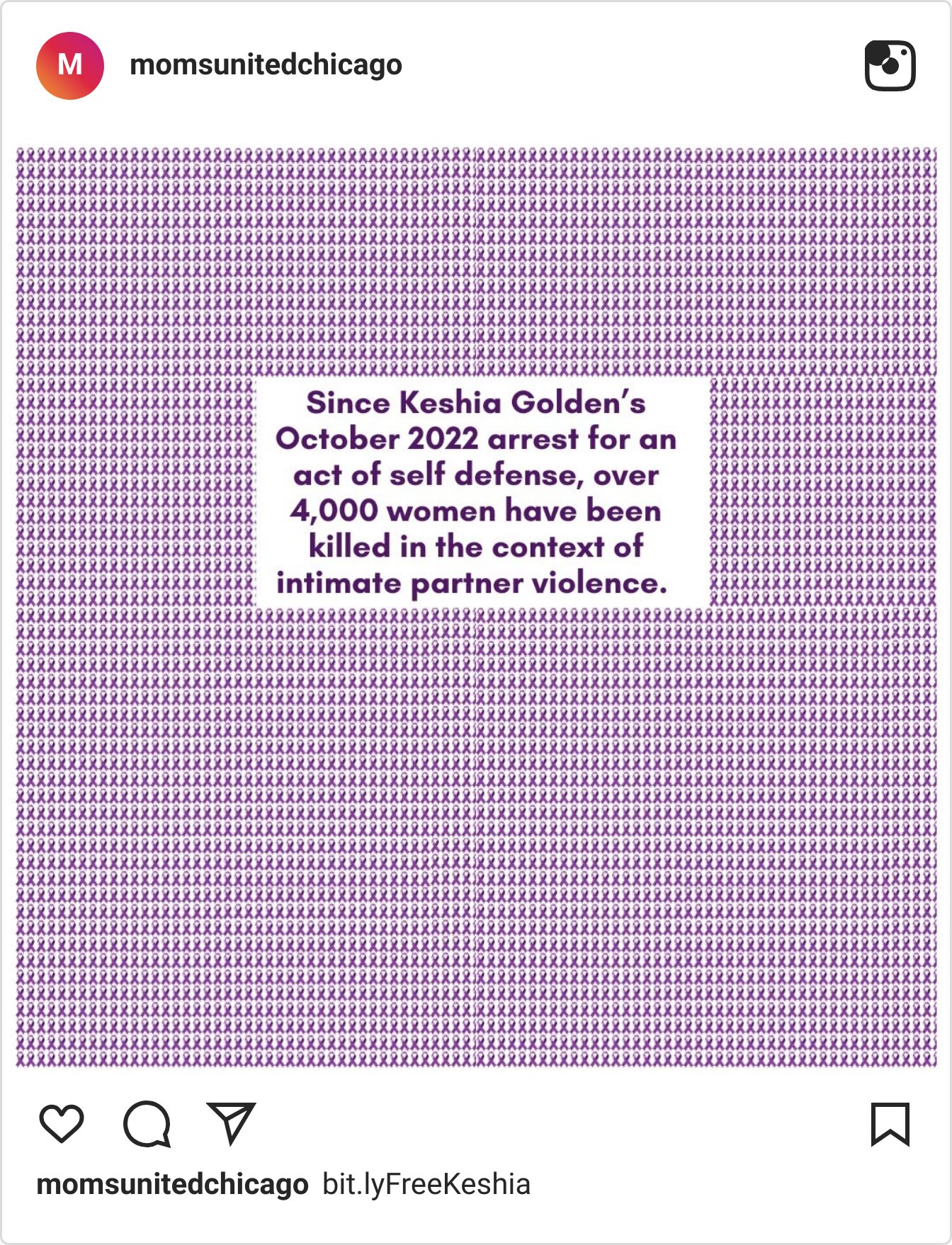
To make matters worse, the media coverage these cases receive too frequently heaps more shame and stigma upon victims. Instead of illuminating the vast systemic issues that make it unfeasible for victims to leave abusive relationships, outlets wait for “perfect victims” to appear and conjure up a feel-good story about justice. When survivors don’t fit that impossible mold, storytellers ranging from local journalists to online content creators can assign blame to them and profit from injustices against them.
In Golden’s case, prosecutors said that she and her partner were arguing over who got to use the microwave, leading to her being called “microwave mom” and belittled by commentators who minimized the abuse she faced. It’s the kind of story I’ve reported on over and over again: Media narratives flatten the cycle of abuse and how victims react to prolonged violence, turning them into the viral villains. When victims are marginalized, tropes like the “angry Black woman” compound existing misogynistic biases.
Ethical, survivor-informed journalism can drive accountability, but it’s a rarity in a sea of click-driven headlines and stories devoid of context. Even when outlets do reporting that helps cases move in a positive direction, organizing director Krig said that reporters often disappear when there’s an update or a new victim needing their attention. For someone like Jasmine, the reporting on her case left her in a worse situation than before.
“People know you from the news, people know you from the newspaper, people just know you,” Jasmine said. “It failed me. It embarrassed me. People look at me twice, even people that don’t know me, and say I’m charged with this and that. The outcome was totally different, but people have one perception in their head of you, or only what they can remember that the media spoke of or put in the newspaper.”
I’m grateful that these women faced the impact of potential retraumatization to share their stories with me. They each deserve more. Golden’s supporters are now arguing that she should be pardoned, so that her life isn’t further encumbered by pleading guilty and being on probation. In the meantime, there’s a fundraiser to support her and her daughter.
“There are a ton more people who are incarcerated for decades to life around the country,” Krig said. “The state certainly doesn’t care about preventing or interrupting or fully funding communities in such a way that people are experiencing safety and wellbeing.”
