Votes are still being counted in Los Angeles, but the early numbers suggest that former reality TV bully-turned-crystal healing influencer Spencer Pratt’s campaign for mayor wasn’t so ill-fated after all. At the time of writing, he has over 30% of the vote and is a close second behind incumbent mayor Karen Bass, who has 35%. The leading leftist candidate, Nithya Raman, is currently in third place with 22% of the vote.
Since no one cleared a majority, that means Bass and Pratt are headed to a runoff election in November. That means five more months of Pratt’s viral, X-driven campaign of dehumanizing homeless people, resharing AI slop, and lobbing immature insults instead of proposing anything resembling a policy. And then, since it’s still liberal LA and Pratt is still a registered Republican with MAGA backing, he’ll most likely lose to Bass. At least, that’s what we hope will happen.
Pratt, who has never held a job outside crafting his onscreen persona, jumped into the race in January on the anniversary of the Pacific Palisades fire that destroyed his home and thousands of others. He channels the rage, terror, and grief that many of us, both Angelenos and outsiders, felt watching the devastation unfold. LA has not recovered. Neither has Hollywood and the entertainment industry. Bass has been skewered for these crises, alongside homelessness, rising utility costs, and general economic woes.
Angelenos are understandably dissatisfied with their current leadership. But while Raman has pages of evidence-based plans to build where Bass left off, Pratt knows that his voters aren’t interested in reading thousands of words. As he bluntly told the New York Times, Pratt says he—and by extension, his supporters—feel like victims, they don’t want to feel that way anymore, and the way to impress them is to say whatever they feel like hearing. In this case, they want to hear Pratt insult women who are actually qualified for the role and degrade the most vulnerable people in LA. Gosh, it all feels so familiar.
Donald Trump was the original reality TV villain to suddenly ascend to political power by reworking the kind of manipulative, devilish persona that hooked audiences on a game show. As it turns out, he wasn’t an aberration. He was the new norm. As my peers in the digital culture space and I have been screaming for years, influence has been redefined by reality series and social media. And platforms led by real-life supervillains like Elon Musk reward their fellow villains with amplification and an easy way to assemble an army of toxic fans.
I was seated in the front row of this cycle for Pratt. He was one of my first “celebrity” followers on X, back when it was still called Twitter. This was around late 2020 or early 2021, when Pratt’s engagement was in the low single digits and his profile picture featured a purple crystal pendant. I had just started reporting full-time on influencers, and Pratt was a 2008 version of one, struggling to hold on to his relevancy in a rapidly shifting online world. He followed and engaged with lots of internet culture reporters back then.

WASHINGTON, D.C. - APRIL 26: (L-R) Perez Hilton, Heidi Montag and Spencer Pratt attend BLOOMBERG 2008 WHITE HOUSE CORRESPONDENT'S DINNER AFTERPARTY at Embassy of Costa Rica on April 26, 2008 in Washington, D.C.. (Photo by BILLY FARRELL/Patrick McMullan via Getty Images)
While I have always expected at least one of my influencer subjects to run for office, Pratt would not have been my first guess. His initial infamy came from The Hills, an MTV reality series about the lives of twenty-something socialites in LA. On there, he became known as a world-class asshole who destroyed the friendship between his wife Heidi Montag and Laguna Beach star Lauren Conrad by spreading rumors about Conrad filming a sex tape. Before that, he also sold stolen photos of underage Mary-Kate Olsen partying to the tabloids. His misogynistic villain arc was no mere performance. His own sister, who he bullied mercilessly onscreen, begged people not to vote for him. She accused him of running just to gin up publicity for his now-bestselling memoir, launched weeks into the campaign, titled The Guy You Loved to Hate: Confessions from a Reality TV Villain.
But in between The Hills and now, Pratt had actually faded into the background, replaced by the viral stars of YouTube and TikTok. It was the tragedy of his house burning down last year that catapulted him and Montag into the public’s sympathy like never before. Previously, “Speidi” was an expression of mockery. Now, more than 150,000 voters think they should move into the Getty House.
Speaking of where Pratt lives, he has managed to use his newfound X clout to dogpile any reporters or critics who mention that he doesn’t even live in LA anymore, which raises the question of whether he’s even allowed to be mayor. To get around this, Pratt claimed he was living in a trailer on his former lot, while TMZ found he was actually staying at the five-star Hotel Bel-Air. He’s not exactly the portrait of your average suffering Angeleno. But his army of MAGA-adjacent X followers is willing to smother anyone who says otherwise.
This is another reason why Musk’s Twitter takeover is so detrimental to the body politic. Take it from me, one of Pratt’s longtime mutuals: he had no traction on Twitter, but he’s a hero on X. That’s not a coincidence. Nor is the fact that Pratt’s meager policy suggestions mirror the “government fraud and abuse” claims that Musk used to justify slashing and burning federal aid with DOGE. Pratt claims he’s going to cut costs, increase government efficiency (DOGE’s supposed purpose), hire more police officers, and purge the streets of homeless people. He’s using the Trump 2.0 playbook while posing as a political independent.
Pratt’s hateful rhetoric about homeless people has been a major driver of his campaign, even as he refers to people as “zombies” and suggests banishing them to other cities. Don’t mistake this for wanting to “fix” the problem of homelessness. Pratt’s classism and ableism toward people suffering from addiction are the vice signaling his supporters seem to identify with the most. Like Trump, he’s giving them permission to loudly hate and attack a marginalized group. Instead of holding the wealthy and powerful accountable, blame the poor.
“Our governments haven’t been doing enough for people, and I think the people who suffer the most from that become, as they always have been, the easiest scapegoats,” said Sherin Varghese, a volunteer I chatted with from Ktown for All, a grassroots organization serving the homeless community in the heart of LA. Ktown for All can’t endorse or oppose political candidates, but Varghese said that politicians tend to vaguely express the need to fund law enforcement and homeless services, but don’t actually implement real solutions once they’re in office. “Politicians are more than happy to throw people who are poor under the bus. This has been true throughout history.”

SHERMAN OAKS, CA - May 16, 2026: A portrait of Los Angeles mayoral candidate Spencer Pratt during a Community Meet and Greet event out of a house for sale on Long Ridge Avenue in a residential neighborhood of Sherman Oaks on Saturday, May 16, 2026. (Etienne Laurent / Los Angeles Times via Getty Images)
IMAGE INSERT: Heidi Montag and Spencer Pratt arrives at the 2008 MTV Movie Awards on June 1, 2008 at the Gibson Amphitheatre in Universal City, California. (Photo by Steve Granitz/WireImage)
When Pratt says he’ll raise budgets for policing and enforcement, that means displacing homeless people, criminalizing them, and punishing them for being unable to afford housing. It doesn’t do anything to address the root cause of homelessness, just like blaming the devastation of the 2025 fires solely on an inefficient government response won’t address the climate change that will lead to more fires in the future.
Pratt isn’t even acknowledging these issues, and Bass’ administration hasn’t done a great job with them either. Meanwhile, Raman had pages and pages of proposals on her website related to climate and affordable housing. Her approach is more reminiscent of Mayor Zohran Mamdani’s in New York City, and while Mamdani had to challenge the Democratic establishment last summer in the form of Andrew Cuomo, Raman had to counter Bass and Pratt simultaneously. The split ultimately hurt Raman the most, when it could have been a race between her and Bass.
Pratt’s reactionary appeal is undermining the chances for a real leftist challenger to shake things up. He doesn’t even have to win to do so. Maybe that’s why millionaires who live outside LA are maxing out donations to his campaign and why the majority of his supporters aren’t Angelenos at all, but are fighting Pratt’s battles on X on behalf of the larger culture war.
Not everyone who is an influencer or who uses social media to reach an audience is a bad candidate by default. This is just how mass media and communications work today, so if you can’t leverage them, you’re increasingly at a disadvantage. But social media platforms also incentivize outrage and drama, just like reality TV. By rewarding the true villains of these spaces with lucrative careers and massive audiences, we’re offering them a clear path to run for office. It once seemed laughable that someone like Pratt or Trump could get elected. We’re not laughing anymore.
Operating under the assumption that what happens on Bravo or TikTok is inconsequential to society at large has enabled a blasé attitude toward onscreen abuse, which means the villains rarely if ever get held accountable. Instead, performative misconduct elevates them to new heights. When the barrier dissolved between influencers and politics, so did any expectation that our new leaders would behave. They were rewarded for being bad, and as it turns out, they can do really bad things in office.
Backrooms and creepypasta’s new potential
Right now, I’m offering a 30-day newsletter bundle deal with Ryan Broderick’s Garbage Day and Dave Jorgenson’s Local News International. You can support all of us and get access to paywalled work for half of what you’d normally pay. Which is a pretty good deal if you ask me!
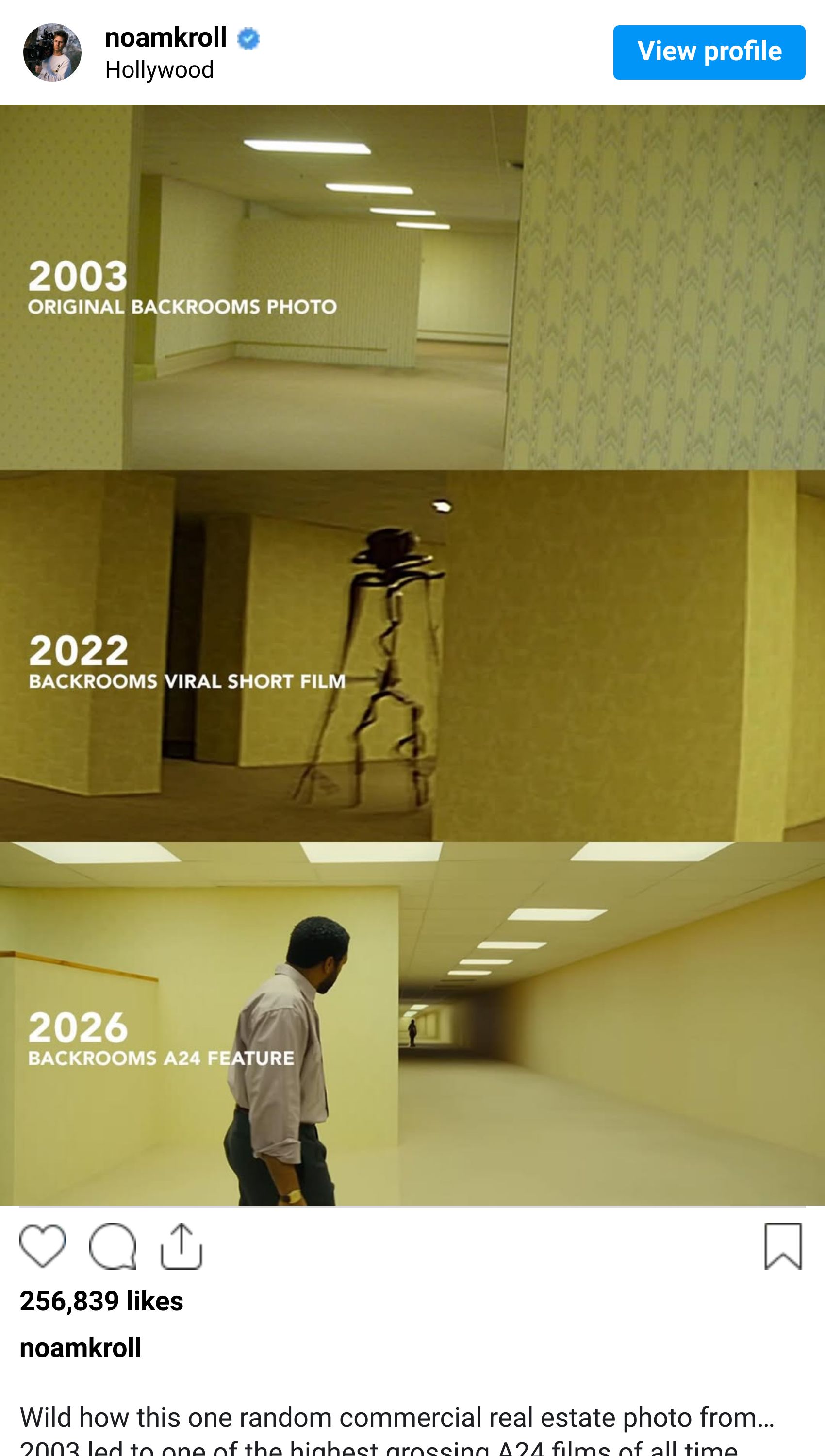
I loved this piece from Garbage Day this week about the movie Backrooms, a surprise hit from a 20-year-old director Kane Parsons. He got his start making short horror films on YouTube inspired by a 4Chan post about another dimension of endless, abstract office spaces with fluorescent lighting and ugly greenish-yellow walls. This has inspired a whole generation of liminal space horror. Backrooms proves there can be a lot of money and enthusiasm in adapting viral mythologies to the big screen.
As a member of Backrooms’ target demo, I grew up loving and being terrified by creepypasta, which is a genre of internet horror stories and urban legends. The most infamous one, of course, is Slenderman, which inspired both an actual stabbing and a really bad movie that flopped. Parsons arguably made the first ever good movie based on creepypasta, but his success doesn’t mean that every future reference will guarantee millions at the box office.
What it does mean is that the communal fandom feeling previously generated by Marvel movies and Star Wars is now happening around stuff that random teenagers came up with online, which I think can be kind of beautiful within reason. I don’t want to see any Wojak movies.