
I’ve got a jam-packed weekend dispatch for you, starting with what happened last night at the White House Correspondents’ Dinner.
For newer subscribers, I was going to reup my piece from last year about attending the WHCD during Donald Trump’s first term in 2018. I was a student scholarship winner, but it left me disillusioned about mainstream political journalism. The piece holds up, but I’d be remiss not to mention the attempted shooting. Fortunately, no one was seriously injured and the parties continued.
It’s notable but unsurprising that the reaction to another presidential assassination attempt was lukewarm at best. Trump immediately tried to leverage the failed attack to justify his corrupt and ridiculous “White House ballroom” project that almost nobody wants. Trump also keeps claiming it’s not taxpayer-funded, even though he wants to build a secretive bunker underneath that American taxpayers probably would be funding.
Trump’s priorities in the aftermath of the attempted shooting certainly didn’t quell the tide of people saying it was staged, just like people think the July 2024 shooting in Butler, Pennsylvania was staged. I don’t believe these shootings were fake, but they are undeniably politically convenient for Trump, so I get why many other people buy into the conspiracies. And that lends itself to what I really want to discuss today, which are some strains of conspiratorial thinking that frustrate me much more.
Virginia Roberts Giuffre is more than a conspiracy
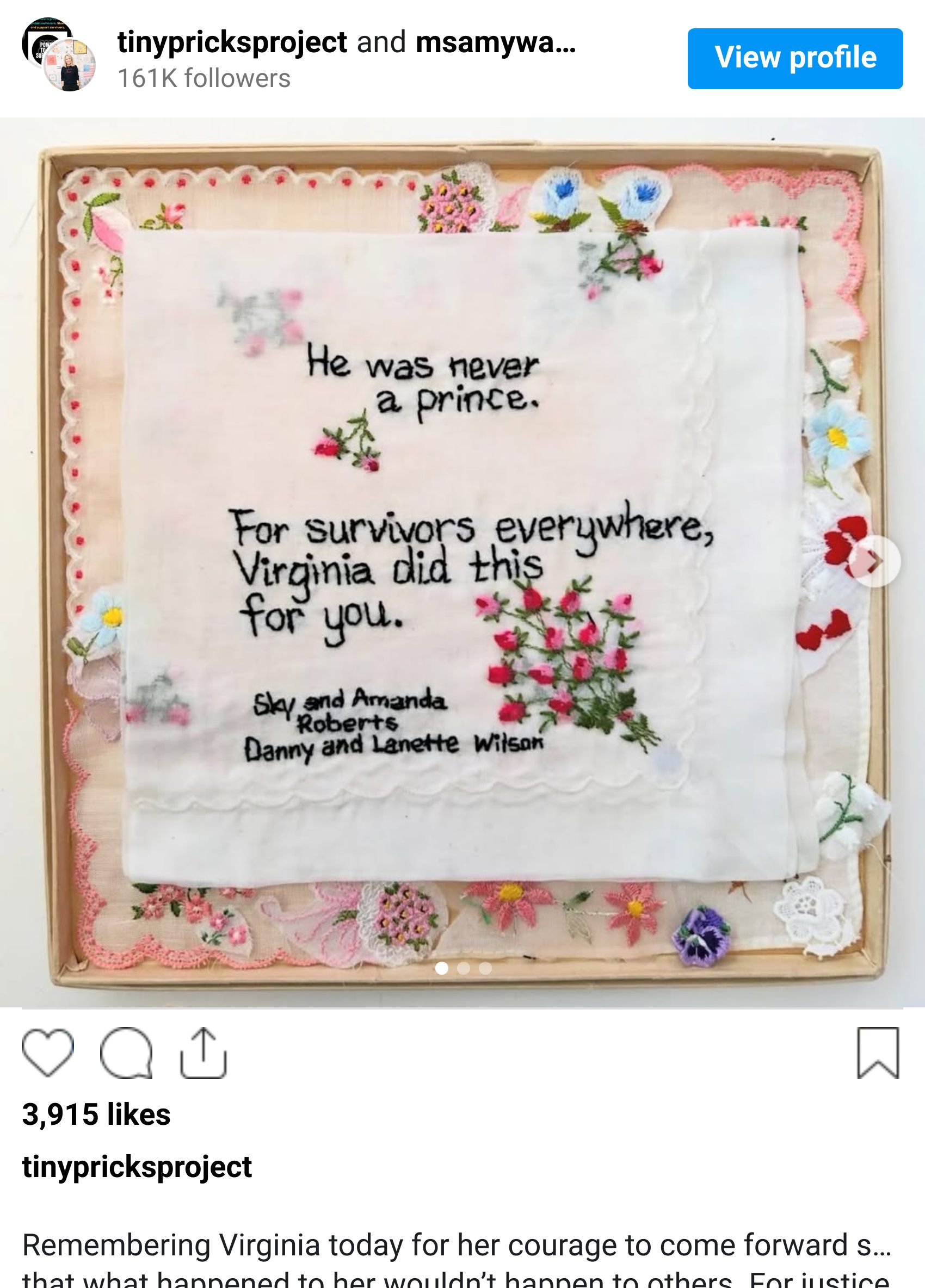
Earlier on Saturday in Washington, D.C., a different group gathered for a decidedly more principled purpose: to honor the life and legacy of Virginia Roberts Giuffre, one of the most prominent victims of Jeffrey Epstein. Virginia gave interviews to journalists, spoke to the FBI, sued Ghislaine Maxwell, and championed Epstein survivors years before most people were aware of his crimes. Her allegations that Epstein trafficked her to Andrew Mountbatten-Windsor resulted in him losing the title of Prince Andrew. Incredibly, a woman from a small rural town in Florida held a member of the British Royal Family to account. She named other alleged perpetrators who have yet to face legal consequences (they and Andrew have all denied the allegations). Virginia’s fight for justice will go down in history. But almost exactly one year ago, she died by suicide at home in Australia.
The Saturday gathering was a vigil for Virginia, as well as a way for her family and other survivors to call for change and real accountability in the U.S. government’s utter mishandling of the Epstein case. Unfortunately, outside Virginia’s survivor community, I’ve noticed that people often reduce her to conspiracies that her death was suspicious. These people include former Congresswoman Marjorie Taylor Greene and Virginia’s own father, who platformed last year on Piers Morgan’s show. Like the now-ubiquitous refrain of Epstein didn’t kill himself, people suggest that Virginia Giuffre didn’t kill herself. She tweeted that she wasn’t suicidal. She knew too much, so they killed her. Who is they? It doesn’t appear to matter.
If people actually listened to Virginia and the people who were closest to her, they would know the truth about her death and the end of her life. If they read her memoir Nobody’s Girl, which was co-written by the journalist Amy Wallace, they would know that Virginia actually attempted suicide multiple times after posting that tweet. They would also know that Virginia says her father was the first person to molest her as a young girl, which he denies. If they cared to look at the evidence published by journalists and corroborated by Virginia’s family, they would see that she also documented her husband Robert Giuffre’s alleged abuse for years, which he denies. In her final months, a court prevented Virginia from being able to see or speak to her children. After an incident where Virginia said Robert beat her to the point she was hospitalized—photos show her covered in bruises—he filed for and received temporary custody. Although many of these details were only disclosed publicly after her death, they reveal a devastating portrait of systemic failure to prevent abuse at every level in countries around the world. Tragically, Virginia was subjected to abuse for most of her life.
That is the true horrifying reality, which is worse than any conspiracy about Virginia’s death. Epstein and his associates didn’t need to murder Virginia to cover up their crimes. She was repeatedly silenced, abused, and failed by abusive men, their enablers, and court systems that protected them and punished her. Some of those men were among the wealthiest in the world. Others were everyday blue collar workers.
A lot of people want to use the parts of Virginia’s story that are the most sensational so they can get engagement and score political points. They want to deny the part of her story that is the most ordinary, the barriers that women around the world in every country and culture and at every income level face. But in the end, the Epstein story isn’t about one man. It’s about an entire backwards system.
Speaking of backwards, pseudo-journalist Michael Tracey crashed Virginia’s memorial yesterday after devoting much of his recent commentary career to smearing her and trying to undermine her credibility. Then he attended Substack’s WHCD party, where he reportedly yelled at, harassed, and intimidated Pulitzer Prize winner Julie K. Brown, who is widely credited with breaking the Epstein story to most of the public. And then he tried to physically fight Jim Acosta, who defended Brown. So can we leave victim-blamers like Tracey firmly in the past and stop inviting him to media parties? Thanks.
A better way to honor Virginia’s legacy is to read this piece from her friend and fellow Epstein survivor Maria Farmer, who stressed the importance of continuing the fight to hold Epstein’s accomplices accountable.
If you or someone you know is in crisis, call 988 to reach the Suicide and Crisis Lifeline. You can also call the National Suicide Prevention Lifeline at 800-273-8255, text HOME to 741741 or visit SpeakingOfSuicide.com/resources.
Michael Jackson’s defenders aren’t all bots

Lionsgate's "Michael" Los Angeles premiere at Dolby Theatre on April 20, 2026 in Los Angeles, California. (Photo by Savion Washington/Getty Images for Lionsgate)
Michael, the new biopic about Michael Jackson co-produced by his estate, is difficult to ignore. Grossing more than $200 million worldwide in its opening weekend, it now has the biggest opening for a musical biopic ever. A few days ago, I went to see a different movie and walked past a line out the door of the theater and down the block to get into an early screening. The movie pointedly does not touch on what are now at least ten child sexual abuse allegations that have been publicly made and/or investigated against the pop icon, involving children as young as seven. He denied them while alive, his estate strongly denies them today, and he was never found guilty (more on that in a second). On social media, where critical reviews, articles, and takes pointing this out have poured in, accounts defending Jackson have rallied to undermine the accusations, harass critics, and smear anyone who believes Jackson abused children. A good indicator of the split is that on the movie review aggregator Rotten Tomatoes, professional reviewers gave the film a 38% critical average, while audience members gave it a 97% rating.
The movie makes no reference to the allegations against Jackson, which is a way of obscuring them and ultimately crafting a revisionist history for the masses. At the same time, Jackson’s estate has been able to silence accusers even further by using a line from a decades-old settlement with HBO to remove the documentary Leaving Neverland from the streaming service. The success of this strategy reinforces a culture that valorizes abusers, because by not even mentioning what Jackson is accused of, the film normalizes the erasure of abuse allegations in defining people’s legacies.
Plus, the most militant Jackson fans are making it harder for anyone to speak up by popularizing victim-blaming rhetoric in his defense and using their strength in numbers to overpower legitimate criticism of their favorite star. These tactics are nothing new, but it’s striking just how many people are willing to spend hours online defending Jackson’s reputation nearly 20 years after his death. Jackson was arguably the biggest celebrity in history, and his music is universal in its appeal. It makes sense that his fandom continues to reflect that. But unfortunately, the dedication of his fans has a real negative impact on how Jackson’s accusers and survivors in general are perceived.
In recent years, I’ve observed a tendency for people to characterize a lot of the accounts defending figures like Jackson as bots. And statistically speaking, some of them are. But when I evaluated the profiles of more than two dozen Jackson defenders across platforms like X, Reddit, and YouTube, I found more evidence than not to suggest they were all real people. The average age of their account was more than 5 years old. Many of them were frequent commenters spanning years of activity. Many of them had profile pictures and other personal information in their bios that appeared to be legitimate. Some of them were even verified professional accounts for people with jobs in the media and entertainment industry. While it might be comforting to imagine that powerful industry players are paying for bot farms to shore up support for Jackson, the reality is that he’s a beloved figure with an army of real keyboard warriors.
And while it might not ultimately be that surprising that Jackson has so much goodwill operating in his favor online, the same can’t be said for any high-profile victim who has ever stepped forward. Even celebrity status doesn’t engender survivors the kind of defense that abusers attract online. There is no true comparable example to the way that fans of abusive men will mobilize on every major social media platform across thousands of accounts. Under seemingly every post about Jackson, they are there fighting with his critics, smearing the children and adults who came forward against him, and insisting that his innocence has been proven.
But while Jackson was never found guilty, that doesn’t mean his accusers were lying. Jackson settled the first case for tens of millions of dollars. Prosecutors struggled to get victims to testify or felt cases lacked sufficient evidence, which are both common hurdles for sexual violence investigations. The bulk of Jackson’s accusers came forward after his death, and courts ruled that some of them could not bring claims regarding Jackson’s conduct against his estate. Another case involving five siblings is relatively recent and has not finished playing out yet in the courts. None of this proves Jackson’s innocence, not even the not guilty verdict from his 2011 trial, which focused on one set of allegations. And jurors referenced the behavior of the alleged victim’s mother as a reason they didn’t view him as credible, which just goes to show that juries are often swayed by unrelated biases. I see a lot of parallels between Jackson’s trial and other ones in pop culture history where juries voted in favor of abusive celebrity men.
Frustratingly, some people have acted like examining the allegations against Jackson works to downplay allegations against other people, like Epstein and Trump. But in actuality, distorting how the legal system evaluates guilt and innocence and the structural barriers that victims face to secure verdicts in their favor hurts everyone. The exact same rhetoric is used by figures like Tracey to undermine victims like Virginia Giuffre. People defend Trump much in the same way that Jackson’s fans defend him, even if they are completely different men without completely different legacies.
For another perspective on Jackson’s popularity, Nadira Goffe wrote a fantastic piece for Slate called “Why So Many Older Black Fans Will Never Give Michael Jackson Up,” which parses the painful context of white supremacy that the desire to exonerate Jackson can’t be untangled from.
“Black people, particularly in the United States, have gone through generations of structural racism that has removed Black men from homes and locked them up in jail cells, often for offenses both minuscule and imaginary […] This nation was founded on discrediting Black people to further exploit them,” Goffe writes. “This may sound like an excuse, but what many don’t understand is how hard it is for older generations to square what has so often happened in the past—the fear that society is just tearing down another good Black man—with the reality that these men could have been, or are convicted of having been, harmful. When it took generations for us to even be allowed on the same stages as white people, let alone loved by them, it is difficult to flip that shiny coin over and see that it is rusting on the other side.”
Wherever survivors turn, they see reminders in our culture at large of how abusers maintain power. The Michael movie is more evidence of that, but so are his legions of defenders who won’t let any critics have the last word.
