
When I planned to go report on the closest National Day of Protest against AI data centers this weekend, I didn’t expect to start the morning with an air quality-induced coughing fit and end it sprinting away from a flash flood in my neighborhood. The nonstop emergency weather alerts in the New York City area this week are a palpable reminder of the consequences when we burn more fossil fuels.
Back in 2024, an X user who has since gone private posted: “Climate change will manifest as a series of disasters viewed through phones with footage that gets closer and closer to where you live until you’re the one filming it.” That post became an instant classic, resurfacing every time a disaster strikes. As I filmed a swell of water cresting over the sidewalk a block away from my apartment on Saturday, the sentiment crossed my mind again. It’s coming true for everyone, sooner than many of us would hope.
And in that moment, as a moving truck began driving (inadvisably) through the floodwater toward me, I realized that the wave was coursing in my direction as a result—and fast. I yelped and took off running back to higher ground. My apartment and I ended up safe, but others aren’t so lucky. When these kinds of storms hit, some New Yorkers drown in illegal basement units. Many of them are immigrants. In Canada last week, an indigenous community fled their homes by boat just in time, as wildfires destroyed everything they had to leave behind. The human cost of climate change will not be dispersed equally. It has already impacted people and their environments along the same lines as other forms of marginalization.
But I’m getting a little ahead of myself. Let’s start with the day of protest.
By the way, I’m able to fund these reporting excursions and share them for free thanks to the generous support of Spitfire News members. If you find value in my work, please consider upgrading your subscription for as low as $5. You’ll get access to my paywalled writing, join my growing Discord community, and support independent journalism that doesn’t rely on corporate interests.

Dozens of New Jerseyans protest the construction of a $1.8 billion data center outside the Kenilworth Municipal Building, where the local city council approved the project in a town of just 8,500 people. Photo by Kat Tenbarge.
Back in March, I reported on a “grassroots” anti-AI organization called Humans First that was rallying NYC leftists while quietly being orchestrated by MAGA Republicans. It was my first inkling that the growing movement against AI and data centers could work in favor of conservatives seeking a new populist identity in the disastrous wake of Trump 2.0. Establishment Democrats and progressives are also rushing to gain a foothold on this issue as it becomes clear that it will influence politics at every level.
As I’ve written about extensively for Spitfire News and other outlets, I largely oppose generative AI in its current form. The tech oligarchs behind most of it are evil, the initial use cases were automated mass sexual abuse, and the industry runs on blatant, all-too-familiar propaganda. That’s before we even get into the environmental concerns around data centers, which emit noise and air pollution, particularly in Black communities—the very definition of environmental racism.
A few weeks ago, I got an email from Humans First about the AI Data Center National Day of Protest they were coordinating in 42 states. Their website is packed with traditional conservative rhetoric about protecting American heritage, child safety (which is often thinly-disguised anti-LGBTQ sentiment), and parents’ rights. There were nearly 150 protests planned, and the closest one to me was in Kenilworth, New Jersey. Not everyone agrees with or even knows about the MAGA background of this organization, just that it’s gaining traction in communities that are already driving their own data center backlashes.
The local protests weren’t all organized directly by Humans First, and this one was led by a real local grassroots group called the Union County Residents Alliance Coalition (UCRAC). They had organized in response to a planned $1.8 billion data center complex in Kenilworth, a town of less than 8,500 people within Union County. It’s already under construction by a cloud-computing company called CoreWeave, which serves customers like OpenAI and Google and sounds suspiciously like the antagonist in a sci-fi series.
As I checked the weather forecast before the protest, I wondered how many people would actually show up in the torrential downpour that was supposed to start during it. Not only was there a flood watch in effect, but there was also an air quality warning in place, setting the tone for why Kenilworth residents didn’t want a massive polluter installed in their neighborhood. As an asthmatic myself, my lungs have been struggling this week. I’m masking and I avoided going outside on the worst days, but I could even smell the smoky wildfire air from Canada in my building’s hallways. Empathizing with these Jerseyans’ concerns, I headed their way.

Blue and pink sidewalk chalk spells out “NO AI” in big block letters outside the Kenilworth Municipal Building on July 18. Photo by Kat Tenbarge.
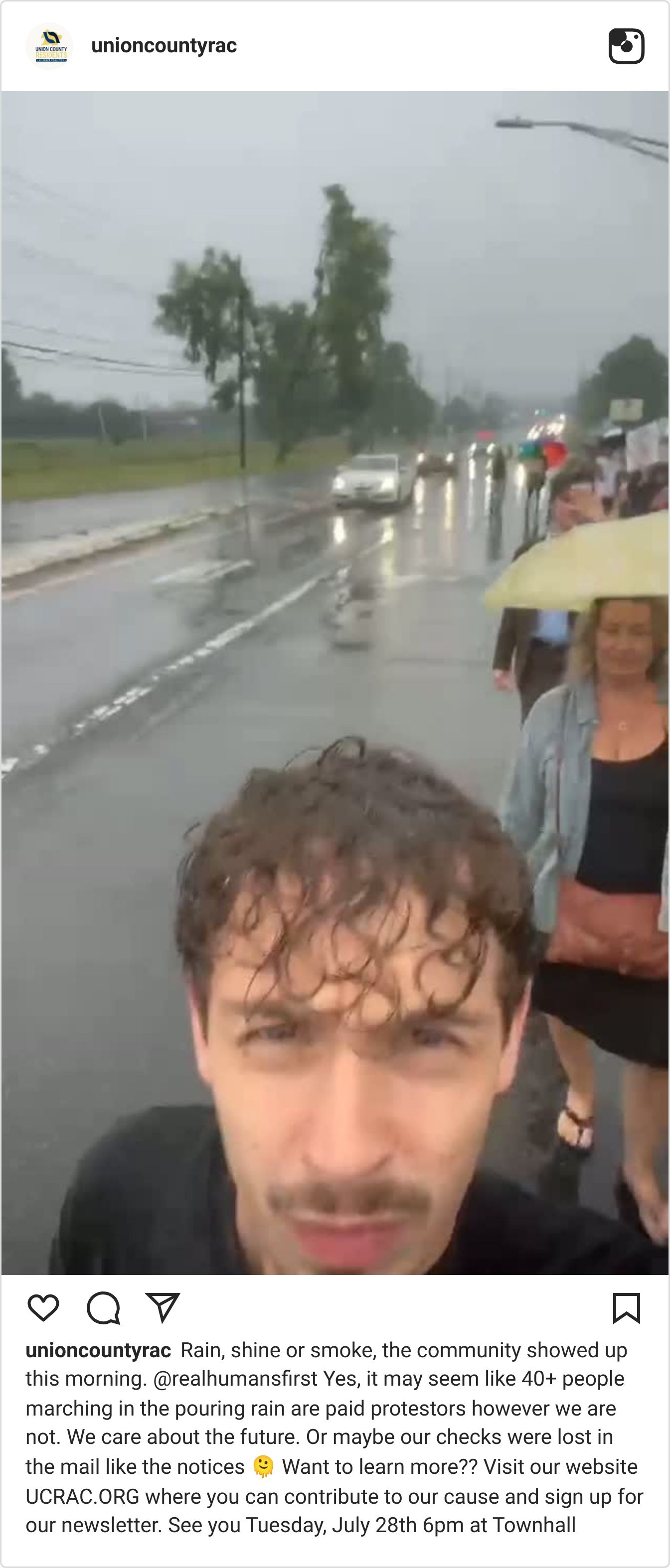
On the road leading to the Kenilworth Municipal Building, where more than 100 UCRAC members and their neighbors held a heated back-and-forth with the city council members who approved the data center complex, I spotted a row of charming local businesses. There was a boutique hotel, a family-owned furniture store, and a bagel shop with big neon signage. And then I saw the protest. With more 40 people lining the main road, they were impossible to miss. Their signs read "Say no to Kenilworth Data Center,” “Water plants, not servers,” “Get out CoreWeave, shame on Kenilworth Council and planning board,” and “People over profit” scrawled over a picture of the town’s mayor Linda Karlovitch. Local indie reporters recently discovered that Karlovitch’s talking points about the data center were written by CoreWeave itself.
On the ground behind the protestors, blue and pink chalk spelled out “NO AI” in big block letters. Cars, city buses, and trucks honked relentlessly in support as they drove by. Chants of “Hey hey, ho ho, data centers have got to go” rang out. I pulled my rain poncho over my head and got to work.
It quickly became apparent that this was a diverse crowd, spanning race, generations, language, and political priors. The first person I interviewed was 22-year-old Alyssa Magnifico, who discovered the data center was happening when noisy construction started up about 200 feet from her house. She lives in the much larger suburb of Union, with a population of around 64,000 people, and the CoreWeave project is right on the border. Many of the UCRAC members live outside Kenilworth, but the data center and its impacts are actually closer to them than the city council.
“Me and my friends, we don’t use generative AI at all. We’re very against it,” Magnifico told me. “The people on the council can’t believe that. We’ve come up here to speak and then they accuse us of using AI to help us.”
@unioncountyrac NEXT MEETING⬇️ 📝July 1st 2026 ⏰Rally 5pm, Meeting 6pm 📍 567 Boulevard, Kenilworth NJ ➡️ Full meetings are on Kenilworths YouTube Channe... See more
Magnifico said she and her friends, who flanked her with signs and noisemakers, lean left, while Kenilworth is something of a Republican pocket in blue New Jersey. But party affiliation wasn’t a dividing force among these protestors. They were united in their desire to recall and replace the council members who voted to pollute their neighborhoods—and drive down their property values. They were furious that the local officials had been unresponsive to their concerns. And they didn’t see the value in putting data centers directly next to people, when job creation benefits were limited and the environmental consequences could be enormous.
“Environmentally, it’s horrendous. It’s going to increase the temperature. It’s going to be a burden on our electrical structure. Everything, water, electricity—our bills are going up. And for what?” asked Wanda España, another Union resident at the protest. “Had they put this to a vote, I’m sure it would not have passed.”
España told me she actually does use generative AI, in the form of Microsoft Copilot at work. But she opposes the sudden rise of massive AI data center complexes and feels they aren’t necessary, pointing to China having far fewer data centers than the U.S. Part of the reason for this is because of America’s established dominance in creating social media platforms and hosting the very data that the UCRAC used to organize, spread awareness, and ultimately connect with Humans First. Renee Spaziani, who helped lead Saturday’s protest, told me that a lot of traditional journalists don’t respond to requests for coverage. As the media industry declines, these anti-big tech groups end up having to rely on big tech just to get the word out.
But I don’t necessarily view that as hypocritical. AI data centers require exponentially more electricity than the data centers that already exist elsewhere. That means producing more emissions. I’ve seen an argument form that these protestors are following the NIMBY (“Not in my backyard”) playbook, but that’s not the entire story. As Astra Taylor and Saul Levin wrote for The Guardian, this is also about democracy and whether people have a say in decisions that impact their lives. One older woman at the protest, Toni, who lives right next to the construction and offered to match donations to UCRAC up to $1,500, is already on permanent oxygen. Spaziani said Toni was hospitalized for multiple days due to fumes from the construction.
“The council says ‘Oh, residents were informed.’ No one was informed,” Spaziani said. “[They’ll] say ‘No Kenilworth residents are here.’ We had two Kenilworth residents, young women who went up to speak, and [they] were the most rude and disrespectful to them.”
As the protest wrapped up, the remaining group started to march down the street and back holding their signs. I followed them for a little bit, but as the rain poured harder and water gushed into my socks and shoes, I thought twice and stayed back under the furniture store’s awning. As the UCRAC members disappeared from view, I genuinely worried that they would get swept away in the storm. But twenty minutes later they reappeared, soaking wet and valiant.
What’s happening in Kenilworth is being replicated in neighborhoods all across the U.S. and beyond. It’s clear that any political movement is going to have to tackle this issue one way or another, and the turnout in the pouring rain on Saturday made me think Humans First has an edge over politicians simply declaring moratoriums or issuing talking points about how we should all own data center profits.
The fact is, we can actually feel the impact of climate change right now. Even I drafted this newsletter, my phone was shrieking with tornado warnings. People can connect the dots, and they’re madder than ever.
